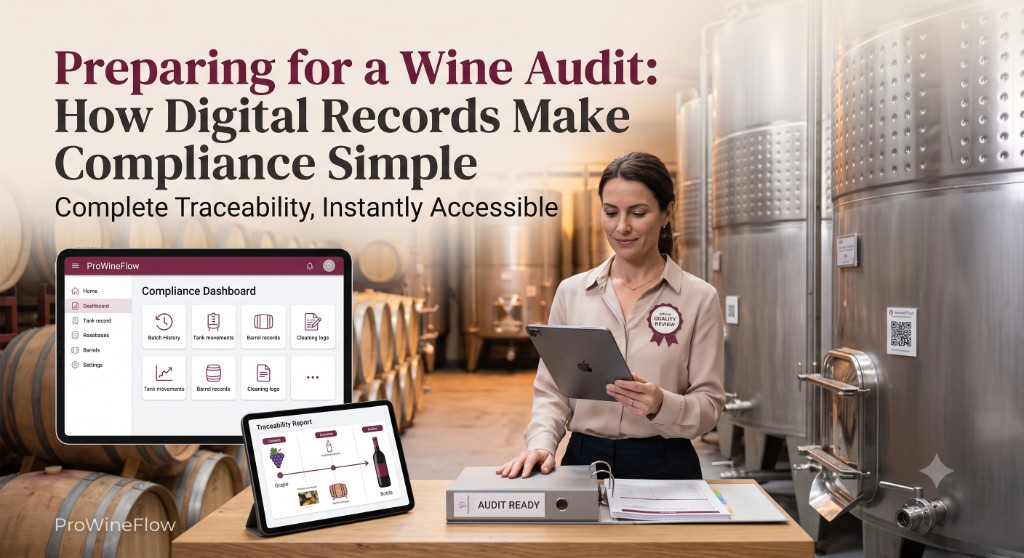
Whether you’re preparing for a customer inspection, an internal quality review, a certification audit or an export compliance assessment, one thing remains constant: your records matter.
An audit is not just about proving that your winery produces great wine. It’s about demonstrating that every stage of production has been carefully documented, that quality procedures have been followed, and that products can be traced accurately from grape receival to the finished bottle.
For many wineries, audit preparation can be stressful. Teams spend days searching through folders, spreadsheets, laboratory reports and handwritten cellar books to gather the required information.
With a digital traceability system, that preparation can be reduced from days to minutes.
Why Wine Audits Are Important
Audits help ensure that wineries maintain high standards of quality, food safety and operational consistency.
Depending on your business, you may undergo:
- Internal quality audits
- Customer or retailer audits
- Export compliance audits
- Food safety audits
- Certification audits
- Sustainability assessments
While every audit is different, they all have one common objective:
Can your winery demonstrate exactly what happened during production?
What Auditors Typically Want to See
Auditors are interested in more than the finished product.
They want confidence that every stage of production has been properly managed and documented.
Typical requests include:
- Batch histories
- Tank movements
- Barrel records
- Cleaning and sanitation logs
- Laboratory analysis
- Additions and treatments
- Equipment maintenance records
- Production procedures
- Calibration records
- Packaging information
- Warehouse inventory
- Staff training records
- Corrective actions
- Product traceability
If these records are scattered across multiple systems—or worse, on paper—finding them can consume valuable time.
The Challenges of Paper-Based Records
Many wineries still rely on:
- Cellar books
- Whiteboards
- Printed worksheets
- Excel spreadsheets
- Filing cabinets
- Individual notebooks
While these methods may work during day-to-day operations, they create challenges during an audit.
Common issues include:
- Missing records
- Illegible handwriting
- Multiple versions of documents
- Lost paperwork
- Time-consuming searches
- Inconsistent data entry
These problems increase stress and reduce confidence during inspections.
Digital Records Create Confidence
Digital traceability transforms audit preparation.
Instead of searching for information, wineries can retrieve complete production histories almost instantly.
For every batch, you can quickly access:
- Vineyard source
- Harvest information
- Tank history
- Barrel history
- Laboratory results
- Production activities
- Cleaning records
- Operator actions
- Packaging details
- Warehouse location
Everything is connected in one place.
Demonstrate Complete Traceability
One of the most important audit requirements is traceability.
Auditors often ask questions such as:
- Which vineyard supplied these grapes?
- Which tanks held this wine?
- Which barrels were used?
- When was filtration completed?
- Which bottling run produced these bottles?
- Which customers received this batch?
A digital traceability platform allows wineries to answer these questions quickly and accurately.
Rather than relying on memory or manually cross-checking paperwork, the information is already linked together.
Keep Equipment Records Up to Date
Wine production depends on reliable equipment.
Auditors may request maintenance and servicing records for:
- Tanks
- Pumps
- Presses
- Crushers
- Filters
- Laboratory equipment
- Bottling lines
- Temperature monitoring systems
Maintaining digital maintenance histories demonstrates that equipment is regularly inspected and maintained according to winery procedures.
It also supports preventative maintenance, reducing the likelihood of unexpected production issues.
Cleaning and Sanitation Matter
Clean equipment is essential for producing high-quality wine.
During an audit, wineries may need to demonstrate:
- Cleaning schedules
- Sanitation procedures
- Chemical usage
- Verification records
- Responsible operators
Digital cleaning logs provide a complete history of every cleaning activity, making it easy to demonstrate that procedures are consistently followed.
Make Batch Investigations Faster
If an auditor selects a specific bottle and asks where it came from, your winery should be able to reconstruct its complete history.
With digital records, you can trace the wine backwards through:
- Bottle
- Bottling run
- Blend
- Barrels
- Tanks
- Fermentation
- Grape receival
- Vineyard block
Likewise, if a problem is discovered earlier in production, you can immediately identify every finished product that may have been affected.
This capability is invaluable for quality investigations and product recalls.
Reduce Audit Stress
Preparation is often the most time-consuming part of an audit.
Instead of spending days collecting documents, digital systems allow wineries to generate reports in minutes.
Benefits include:
- Faster document retrieval
- Better organised records
- Improved consistency
- Reduced manual administration
- Greater confidence during inspections
- Less disruption to cellar operations
When information is already organised, audits become routine rather than stressful.
Best Practices for Audit Readiness
Regardless of winery size, a few simple practices make every audit easier.
1. Record Activities as They Happen
Capture production events immediately instead of updating records later.
Real-time data is more accurate and less likely to be forgotten.
2. Digitise Your Cellar
Replace paper records with mobile data collection wherever possible.
This reduces transcription errors and improves accessibility.
3. Give Every Asset a Digital Identity
Assign QR codes or digital identifiers to:
- Tanks
- Barrels
- Pumps
- Filters
- Laboratory equipment
- Pallets
- Storage locations
Every asset should have a complete history.
4. Standardise Procedures
Use consistent workflows for production, cleaning, maintenance and inspections.
Consistency improves both operational efficiency and audit performance.
5. Review Records Regularly
Don’t wait until audit week.
Routine reviews help identify missing information long before an auditor arrives.
Digital Traceability Is More Than Compliance
Many wineries adopt digital systems to simplify audits.
They soon discover additional benefits:
- Better production planning
- Improved cellar visibility
- Reduced paperwork
- More accurate inventory
- Faster decision-making
- Improved communication
- Higher operational efficiency
Compliance becomes a natural outcome of good operational management.
How ProWineFlow Helps
ProWineFlow has been designed specifically for modern winery operations.
By combining QR code technology, mobile data capture and on-device traceability, it provides a complete digital history of every stage of production.
With ProWineFlow, wineries can:
- Track batches from vineyard to bottle
- Record tank and barrel movements
- Maintain digital cleaning logs
- Manage equipment maintenance
- Capture production activities in real time
- Generate traceability reports instantly
- Simplify audit preparation
- Improve compliance and operational visibility
Instead of spending valuable time searching for records, your team can focus on making exceptional wine.
Be Audit Ready Every Day
The best wineries don’t prepare for audits once a year.
They build systems that keep them audit-ready every day.
When production data is captured digitally, every movement is recorded, every asset is traceable and every batch has a complete history.
Audits become faster.
Compliance becomes simpler.
And your winery gains the confidence that comes from knowing every bottle has a story that can be proven from vineyard to customer.
That’s the true value of end-to-end wine traceability.