Every litre of wine has a story.
From the moment grapes arrive at the winery until the finished bottles leave the warehouse, wine passes through numerous tanks during crushing, fermentation, blending, stabilisation, maturation and preparation for bottling.
Yet many wineries still rely on whiteboards, spreadsheets or paper records to track where each tank is, what’s inside it, and what needs to happen next.
As production grows, this approach becomes increasingly difficult to manage.
Digital tank tracking provides wineries with real-time visibility, improves operational efficiency and significantly reduces the risk of costly mistakes.
Why Tank Tracking Matters
Wine tanks are more than simple storage vessels—they are the heart of cellar operations.
Every day, cellar teams need answers to questions such as:
- Which tanks are currently occupied?
- What wine is inside each tank?
- How much volume remains?
- When did fermentation begin?
- Which treatments have been completed?
- What operation is scheduled next?
- Is the tank available for the next vintage?
Without a centralised system, this information is often scattered across multiple documents, making it difficult to maintain an accurate picture of the cellar.
The Challenges of Manual Tank Management
Many wineries experience similar problems:
- Searching for the latest spreadsheet version
- Handwritten notes that are difficult to read
- Whiteboards that quickly become outdated
- Duplicate data entered into multiple systems
- Delayed communication between cellar staff
- Human errors during transfers or blending
Even a small mistake can result in production delays, additional labour, or compliance issues.
Give Every Tank a Digital Identity
The first step towards digital traceability is simple:
Assign every tank a unique digital identity.
This can be achieved using:
- QR Codes
- RFID tags
- NFC tags
- Permanent asset identification labels
Each tank becomes a digital asset with its own complete history.
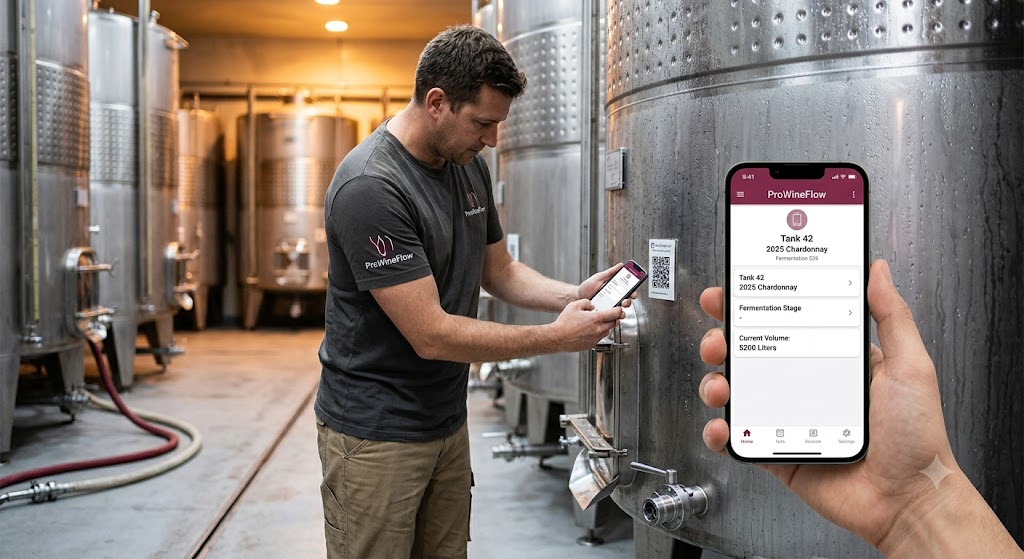
Instead of searching through paperwork, staff simply scan the tank using a mobile device.
Within seconds they can view:
- Tank specifications
- Current contents
- Capacity
- Fill level
- Batch information
- Previous operations
- Cleaning history
- Maintenance records
- Upcoming scheduled tasks
The result is instant access to accurate information wherever the team is working.
Track Every Movement
Tank tracking goes far beyond identifying where a tank is located.
Every operation performed on the tank becomes part of its permanent digital record.
Examples include:
- Filling
- Transfers
- Fermentation
- Additions
- Temperature monitoring
- Laboratory samples
- Cleaning
- Sanitisation
- Blending
- Racking
- Emptying
- Maintenance
Each event is automatically linked to:
- Date and time
- Operator
- Batch or lot number
- Equipment used
- Production stage
This creates complete traceability throughout the wine production process.
Improve Cellar Planning
Knowing exactly which tanks are available helps wineries optimise production planning.
Instead of walking through the cellar to determine available capacity, managers can instantly see:
- Occupied tanks
- Available tanks
- Tanks scheduled for cleaning
- Tanks awaiting maintenance
- Tanks reserved for upcoming harvest
This visibility allows better scheduling and reduces production bottlenecks during busy periods.
Simplify Compliance and Audits
Traceability requirements continue to increase across the wine industry.
Whether preparing for internal quality audits, customer requirements or export documentation, wineries need accurate production records.
A digital tank history provides clear evidence of:
- Product movements
- Cleaning procedures
- Operator actions
- Batch genealogy
- Equipment usage
- Maintenance activities
Instead of searching through folders, the complete history is available with a few clicks.
Connect Tanks to the Entire Cellar
Modern wineries don’t manage tanks in isolation.
Each tank interacts with:
- Pumps
- Hoses
- Valves
- Filters
- Laboratory equipment
- Barrels
- Bottling lines
- Warehouses
By connecting these assets together, wineries gain complete visibility of production from grape intake to finished bottle.
This creates a digital thread across the entire cellar.
The Benefits of Digital Tank Tracking
Wineries that adopt digital tank management typically experience:
- Reduced manual administration
- Improved operational visibility
- Faster decision-making
- Better utilisation of tank capacity
- Fewer production errors
- Easier compliance reporting
- Improved communication between teams
- Greater confidence in production data
Most importantly, staff spend less time searching for information and more time making great wine.
How ProWineFlow Helps
ProWineFlow has been designed specifically for winery operations.
Using QR code technology, mobile devices and on-device software, cellar teams can track every tank in real time while maintaining a complete digital history of production.
Whether you operate a boutique winery or a large multi-site operation, digital tank tracking provides the visibility needed to improve efficiency, reduce errors and strengthen traceability.
The future of winery management isn’t about collecting more data.
It’s about making the right information available to the right people at exactly the right time.
Ready to Modernise Your Cellar?
If your winery still relies on paper records, spreadsheets or whiteboards, now is the perfect time to take the next step.
Digital tank tracking is one of the simplest ways to improve cellar efficiency while building a stronger foundation for complete winery traceability.
Because every great wine deserves a complete history.