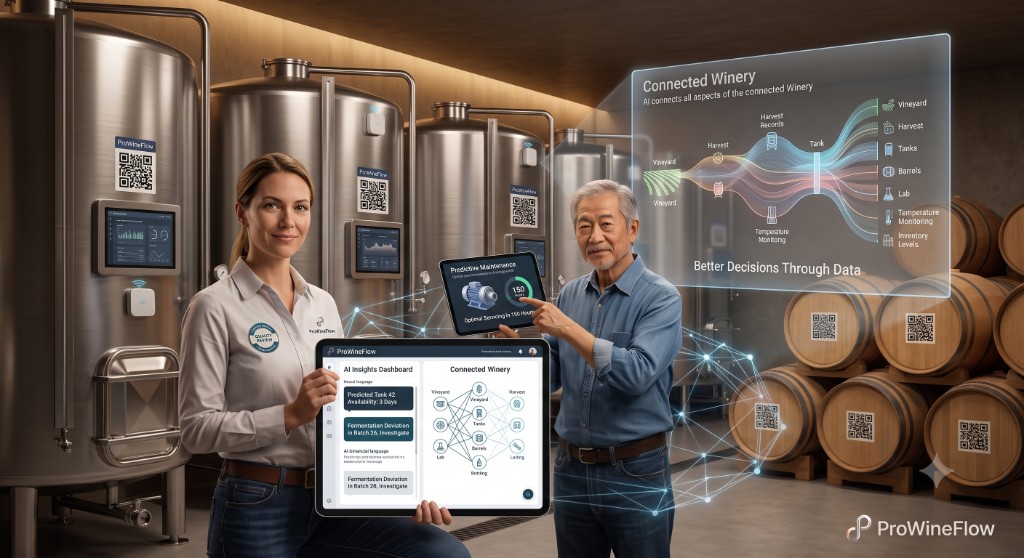
Artificial Intelligence (AI) is no longer a futuristic concept reserved for large technology companies.
Today, wineries of all sizes are beginning to use AI to improve production planning, optimise cellar operations, reduce waste and make better decisions based on real-time data.
Importantly, AI is not replacing the experience and intuition of the winemaker.
Instead, it acts as a powerful assistant—helping teams analyse more information, identify trends faster and automate repetitive tasks so they can focus on producing exceptional wines.
As digital traceability becomes standard across the wine industry, AI is emerging as the next step in the evolution of the connected winery.
What Is AI in a Winery?
Artificial Intelligence uses data to recognise patterns, make predictions and provide recommendations.
In a winery, AI can analyse information from across the entire production process, including:
- Vineyard data
- Harvest records
- Tank activity
- Barrel inventories
- Laboratory results
- Temperature monitoring
- Equipment maintenance
- Production schedules
- Inventory levels
- Sales forecasts
Rather than looking at each dataset separately, AI connects them to provide insights that would be difficult to discover manually.
Better Decisions Through Data
Every day, wineries generate thousands of pieces of information.
Without the right tools, much of this valuable data remains unused.
AI helps transform raw information into practical recommendations.
For example, AI can help answer questions such as:
- Which tanks will become available next week?
- Are there any fermentation batches behaving differently?
- Which barrels are due for replacement?
- Which equipment is likely to require maintenance?
- Where are production bottlenecks developing?
- Which wines should be prioritised for bottling?
Instead of reacting to problems after they occur, managers can take action earlier.
Smarter Production Planning
Vintage is one of the busiest and most demanding periods of the year.
Tank space becomes limited.
Barrels need to be allocated.
Equipment is constantly moving.
Production schedules change daily.
AI can analyse production capacity and recommend more efficient scheduling by considering:
- Tank availability
- Fermentation timelines
- Cleaning schedules
- Equipment availability
- Staff workloads
- Bottling plans
This helps wineries reduce delays and make better use of available resources.
Predictive Maintenance
Unexpected equipment failures can be expensive.
A pump failure during harvest or a bottling line breakdown can disrupt production and increase costs.
AI helps shift maintenance from reactive to predictive.
Instead of waiting for equipment to fail, AI analyses:
- Running hours
- Usage frequency
- Maintenance history
- Inspection reports
- Sensor data
The system can identify equipment that may soon require servicing, allowing maintenance to be scheduled before a breakdown occurs.
This reduces downtime while extending the lifespan of valuable assets.
Improving Wine Traceability
Modern wineries already collect large amounts of production data.
AI makes that information more useful.
Instead of manually searching through records, users can simply ask questions such as:
- Which barrels contain this batch?
- Show every wine produced from Block 12.
- Which tanks are awaiting cleaning?
- Which wines used French oak barrels for more than twelve months?
- Which batches were filtered last week?
AI searches the available information and provides answers in seconds.
This makes traceability faster and significantly reduces the time required for investigations and audits.
Reducing Waste
Every litre of wine matters.
AI can help wineries reduce waste by identifying patterns that may otherwise go unnoticed.
Examples include:
- Repeated transfer losses
- Underutilised tanks
- Inefficient production sequences
- Excess cleaning cycles
- Overstocked dry goods
- Slow-moving inventory
Small improvements across multiple areas can lead to significant savings over the course of a vintage.
Supporting Quality Control
Quality remains at the heart of every successful winery.
AI does not decide how wine should taste.
That remains the responsibility of experienced winemakers.
However, AI can support quality teams by highlighting unusual trends, including:
- Unexpected fermentation behaviour
- Temperature deviations
- Laboratory values outside expected ranges
- Delayed production stages
- Missing production records
Early detection allows wineries to investigate issues before they become larger problems.
AI-Powered Reporting
Preparing reports can consume valuable time.
Production managers often need summaries covering:
- Tank utilisation
- Barrel inventories
- Vintage progress
- Production volumes
- Cleaning activities
- Maintenance schedules
- Inventory status
AI can automatically generate these reports, highlight important changes and even explain trends using plain language.
Instead of spending hours creating spreadsheets, teams can focus on analysing results and making informed decisions.
AI Works Best with Good Data
Artificial Intelligence is only as effective as the information it receives.
If production records are incomplete or scattered across paper documents and spreadsheets, AI has very little to work with.
This is why digital traceability is the foundation of AI.
By capturing production activities in real time—using QR codes, mobile devices and digital workflows—wineries create reliable data that AI can analyse.
Good data leads to better insights.
Better insights lead to better decisions.
The Human Winemaker Remains Essential
One of the biggest misconceptions about AI is that it replaces people.
In reality, the opposite is true.
AI supports experienced professionals by reducing administrative work and providing additional information when decisions need to be made.
The creativity, intuition and craftsmanship of the winemaker remain irreplaceable.
AI simply provides another tool to help achieve consistent quality and greater operational efficiency.
The Future of AI in Wineries
Over the coming years, AI will become increasingly integrated into everyday winery operations.
Future capabilities may include:
- Conversational assistants that answer production questions instantly
- Automatic production scheduling
- Predictive harvest planning
- Intelligent inventory optimisation
- Real-time operational dashboards
- Automated compliance reporting
- Early quality risk detection
- Energy and water usage optimisation
As digital technologies continue to evolve, wineries that embrace AI will be better positioned to respond to changing market demands and operate more efficiently.
How ProWineFlow Uses AI
ProWineFlow combines digital traceability with intelligent analytics to help wineries gain more value from their production data.
By connecting tanks, barrels, equipment, batches and production activities into a single platform, ProWineFlow provides the foundation for AI-driven winery management.
With ProWineFlow, wineries can:
- Search production records using natural language
- Analyse trends across multiple vintages
- Identify operational bottlenecks
- Improve production planning
- Monitor asset performance
- Generate intelligent reports
- Strengthen traceability and compliance
- Support faster, data-driven decisions
AI becomes a practical tool that helps wineries work smarter—not harder.
Building the Winery of Tomorrow
The future of winemaking is built on a combination of tradition and technology.
Centuries of experience will always shape great wines.
Artificial Intelligence simply helps wineries manage increasing complexity with greater confidence.
By combining digital traceability, connected assets and AI-powered insights, wineries can improve efficiency, reduce risk and make better decisions at every stage of production.
The wineries that embrace AI today are not replacing tradition.
They are giving their teams better tools to protect it, improve it and continue producing exceptional wines for generations to come.